


Optical communication band, ultra-nipis nga optical resonator
Ang mga optical resonator maka-localize sa espesipikong mga wavelength sa mga light wave sa limitado nga espasyo, ug adunay importanteng mga aplikasyon sa interaksyon sa light-matter,komunikasyon sa optika, optical sensing, ug optical integration. Ang gidak-on sa resonator nagdepende sa mga kinaiya sa materyal ug sa operating wavelength, pananglitan, ang mga silicon resonator nga naglihok sa near infrared band kasagaran nanginahanglan og optical structures nga gatosan ka nanometers pataas. Sa bag-ohay nga mga tuig, ang ultra-thin planar optical resonators nakadani og daghang atensyon tungod sa ilang potensyal nga aplikasyon sa structural color, holographic imaging, light field regulation ug optoelectronic devices. Ang pagminus sa gibag-on sa planar resonators usa sa mga lisod nga problema nga giatubang sa mga tigdukiduki.
Lahi sa tradisyonal nga mga materyales sa semiconductor, ang 3D topological insulators (sama sa bismuth telluride, antimony telluride, bismuth selenide, ug uban pa) mga bag-ong materyales sa impormasyon nga adunay topologically protected metal surface states ug insulator states. Ang surface state gipanalipdan sa symmetry sa time inversion, ug ang mga electron niini wala nagkatibulaag sa mga non-magnetic impurities, nga adunay importanteng mga posibilidad sa aplikasyon sa low-power quantum computing ug spintronic devices. Sa samang higayon, ang mga topological insulator materials nagpakita usab og maayo kaayong optical properties, sama sa taas nga refractive index, dako nga nonlinear.optikalcoefficient, lapad nga working spectrum range, tunability, dali nga integration, ug uban pa, nga naghatag og bag-ong plataporma para sa pagkaamgo sa light regulation ugmga aparato nga optoelektroniko.
Usa ka research team sa China ang nagsugyot og pamaagi para sa paghimo og ultra-thin optical resonators gamit ang large area growing bismuth telluride topological insulator nanofilms. Ang optical cavity nagpakita og klaro nga resonance absorption characteristics sa near infrared band. Ang Bismuth telluride adunay taas kaayo nga refractive index nga labaw sa 6 sa optical communication band (mas taas kay sa refractive index sa tradisyonal nga high refractive index materials sama sa silicon ug germanium), aron ang gibag-on sa optical cavity makaabot sa ika-baynte sa resonance wavelength. Sa samang higayon, ang optical resonator ideposito sa usa ka one-dimensional photonic crystal, ug usa ka bag-ong electromagnetically induced transparency effect ang naobserbahan sa optical communication band, nga tungod sa coupling sa resonator sa Tamm plasmon ug sa destructive interference niini. Ang spectral response niini nga epekto nagdepende sa gibag-on sa optical resonator ug lig-on sa pagbag-o sa ambient refractive index. Kini nga trabaho nagbukas og bag-ong paagi para sa pagkaamgo sa ultrathin optical cavity, topological insulator material spectrum regulation ug optoelectronic devices.
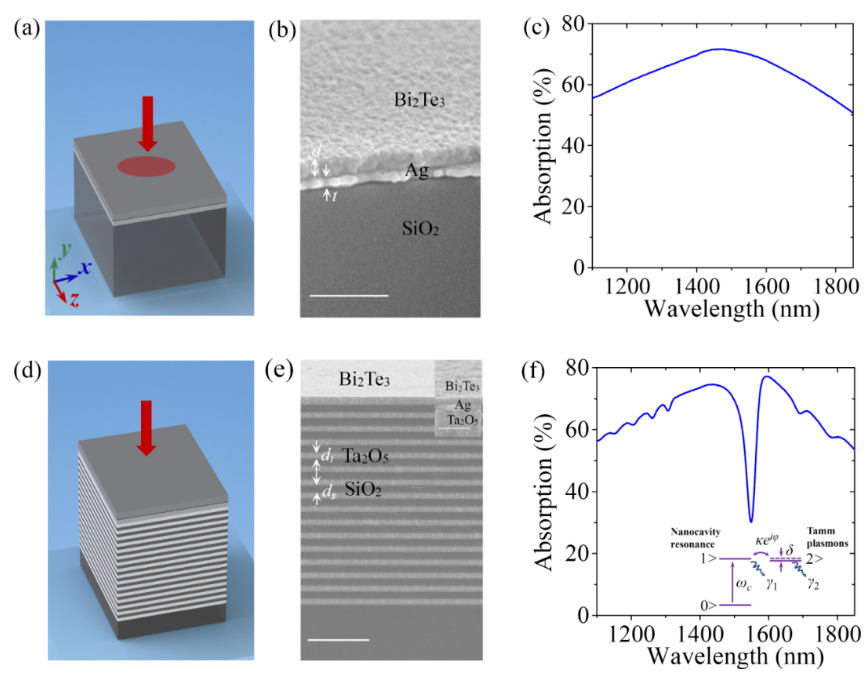
Sama sa gipakita sa FIG. 1a ug 1b, ang optical resonator gilangkoban sa bismuth telluride topological insulator ug silver nanofilms. Ang bismuth telluride nanofilms nga giandam pinaagi sa magnetron sputtering adunay dako nga area ug maayong flatness. Kung ang gibag-on sa bismuth telluride ug silver films kay 42 nm ug 30 nm, matag usa, ang optical cavity nagpakita og kusog nga resonance absorption sa band nga 1100~1800 nm (Figure 1c). Sa dihang gi-integrate sa mga tigdukiduki kini nga optical cavity ngadto sa usa ka photonic crystal nga hinimo sa nagpuli-puli nga mga stack sa Ta2O5 (182 nm) ug SiO2 (260 nm) nga mga layer (Figure 1e), usa ka lahi nga absorption valley (Figure 1f) ang mitumaw duol sa orihinal nga resonant absorption peak (~1550 nm), nga susama sa electromagnetically induced transparency effect nga gihimo sa mga atomic system.
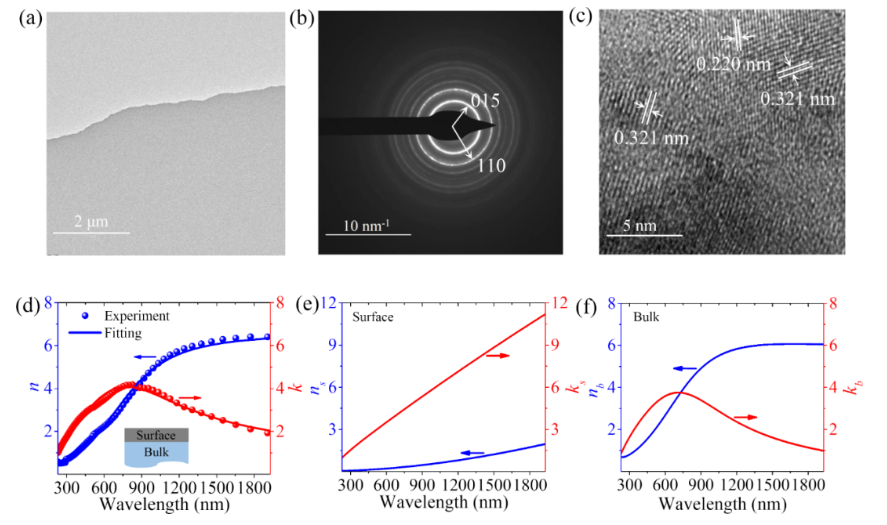
Ang bismuth telluride nga materyal gihulagway pinaagi sa transmission electron microscopy ug ellipsometry. Ang FIG. 2a-2c nagpakita sa transmission electron micrographs (mga high-resolution nga imahe) ug pinili nga mga electron diffraction pattern sa bismuth telluride nanofilms. Makita gikan sa hulagway nga ang giandam nga bismuth telluride nanofilms mga polycrystalline nga materyales, ug ang pangunang oryentasyon sa pagtubo mao ang (015) crystal plane. Ang Figure 2d-2f nagpakita sa complex refractive index sa bismuth telluride nga gisukod sa ellipsometer ug sa fitted surface state ug state complex refractive index. Ang mga resulta nagpakita nga ang extinction coefficient sa surface state mas dako kay sa refractive index sa range nga 230~1930 nm, nga nagpakita sa mga kinaiya nga sama sa metal. Ang refractive index sa lawas labaw sa 6 kung ang wavelength labaw sa 1385 nm, nga mas taas kaysa sa silicon, germanium ug uban pang tradisyonal nga high-refractive index nga mga materyales niini nga banda, nga nagbutang ug pundasyon alang sa pag-andam sa ultra-thin optical resonators. Gipunting sa mga tigdukiduki nga kini ang unang gitaho nga pagkaamgo sa usa ka topological insulator planar optical cavity nga adunay gibag-on nga napulo ka nanometer lamang sa optical communication band. Sunod, ang absorption spectrum ug resonance wavelength sa ultra-thin optical cavity gisukod gamit ang gibag-on sa bismuth telluride. Sa katapusan, gisusi ang epekto sa gibag-on sa silver film sa electromagnetically induced transparency spectra sa bismuth telluride nanocavity/photonic crystal structures.
Pinaagi sa pag-andam og lapad nga patag nga nipis nga mga pelikula sa bismuth telluride topological insulators, ug pagpahimulos sa ultra-high refractive index sa mga materyales sa Bismuth telluride sa duol nga infrared band, usa ka planar optical cavity nga adunay gibag-on nga napulo ka nanometer lamang ang makuha. Ang ultra-thin optical cavity makahimo og episyente nga resonant light absorption sa duol nga infrared band, ug adunay importante nga bili sa aplikasyon sa pagpalambo sa mga optoelectronic device sa optical communication band. Ang gibag-on sa bismuth telluride optical cavity linear sa resonant wavelength, ug mas gamay kaysa sa susamang silicon ug germanium optical cavity. Sa samang higayon, ang bismuth telluride optical cavity gi-integrate sa photonic crystal aron makab-ot ang anomalous optical effect nga susama sa electromagnetically induced transparency sa atomic system, nga naghatag og bag-ong pamaagi alang sa spectrum regulation sa microstructure. Kini nga pagtuon adunay papel sa pagpasiugda sa panukiduki sa mga topological insulator materials sa light regulation ug optical functional devices.
Oras sa pag-post: Sep-30-2024